Friday, 7 March 2014

10 Ways to Go Green and Save Green

  1. Save energy to save money.
    • Set your thermostat a few degrees lower in the winter and a few degrees higher in the summer to save on heating and cooling costs.
    • Install compact fluorescent light bulbs (CFLs) when your older incandescent bulbs burn out.
    • Unplug appliances when you're not using them. Or, use a "smart" power strip that senses when appliances are off and cuts "phantom" or "vampire" energy use.
    • Wash clothes in cold water whenever possible. As much as 85 percent of the energy used to machine-wash clothes goes to heating the water.
    • Use a drying rack or clothesline to save the energy otherwise used during machine drying
      .
  2. Save water to save money.
    • Take shorter showers to reduce water use. This will lower your water and heating bills too.
    • Install a low-flow showerhead. They don't cost much, and the water and energy savings can quickly pay back your investment.
    • Make sure you have a faucet aerator on each faucet. These inexpensive appliances conserve heat and water, while keeping water pressure high.
    • Plant drought-tolerant native plants in your garden. Many plants need minimal watering. Find out which occur naturally in your area.
  3. Less gas = more money (and better health!).

    • Walk or bike to work. This saves on gas and parking costs while improving your cardiovascular health and reducing your risk of obesity.
    • Consider telecommuting if you live far from your work. Or move closer. Even if this means paying more rent, it could save you money in the long term.
    • Lobby your local government to increase spending on sidewalks and bike lanes. With little cost, these improvements can pay huge dividends in bettering your health and reducing traffic.
  4. Eat smart.
  5. Skip the bottled water.

     
    • Use a water filter to purify tap water instead of buying bottled water. Not only is bottled water expensive, but itgenerates large amounts of container waste.
    • Bring a reusable water bottle, preferably aluminum rather than plastic, with you when traveling or at work.
    • Check out this short article for the latest on bottled water trends.
  6. Think before you buy.

     
    • Go online to find new or gently used secondhand products. Whether you've just moved or are looking to redecorate, consider a service like craigslist orFreeSharing to track down furniture, appliances, and other items cheaply or for free.
    • Check out garage sales, thrift stores, and consignment shops for clothing and other everyday items.
    • Watch a video about what happens when you buy things. Your purchases have a real impact, for better or worse.
  7. Borrow instead of buying.
    • Borrow from libraries instead of buying personal books and movies. This saves money, not to mention the ink and paper that goes into printing new books.
    • Share power tools and other appliances. Get to know your neighbors while cutting down on the number of things cluttering your closet or garage.
  8. Buy smart.

    • Buy in bulk. Purchasing food from bulk bins can save money and packaging.
    • Wear clothes that don't need to be dry-cleaned. This saves money and cuts down on toxic chemical use.
    • Invest in high-quality, long-lasting products. You might pay more now, but you'll be happy when you don't have to replace items as frequently (and this means less waste!).
  9. Keep electronics out of the trash.
    • Keep your cell phones, computers, and other electronics as long as possible.
    • Donate or recycle them responsibly when the time comes. E-waste contains mercury and other toxics and is a growing environmental problem.
    • Recycle your cell phone.
    • Ask your local government to set up an electronics recycling and hazardous waste collection event.
  10. Make your own cleaning supplies.
    • The big secret: you can make very effective, non-toxic cleaning products whenever you need them. All you need are a few simple ingredients like baking soda, vinegar, lemon, and soap.
    • Making your own cleaning products saves money, time, and packaging-not to mention your indoor air quality.

4 Easy Tips To Make Your Holiday Kitchen Greener


The holiday season is upon us! For most of you, that means spending a lot more time in the kitchen - whether you're hosting a party or simply cooking a traditional meal for your family. No matter what the reason, you're going to shop for many ingredients, cook, clean, and enjoy lots of yummy food (let's hear it for the leftovers)!

If you're like me (and I'll bet you are, since you're here), you want to buy quality food that is also healthy for your family, while keeping costs down. I've done the legwork for you and created a list of tips to help you accomplish your "green" feasts.

Here are 4 easy tips to keep in mind as you shop, cook, eat and clean: 

- Choose food low added chemicals and toxins

- Avoid toxic chemicals in cookware

- Store and reheat your leftovers safely

- Clean the greener way!

1) CHOOSE FOOD LOW IN POLLUTANTS AND ADDED CHEMICALS:

As you may already know, today's food can contain ingredients that you definitely don't want to eat, such as: pesticides, hormones, artificial additives and chemicals found in food packaging.

Here are 3 ways that you can cut down on these types of chemicals: 

When you go grocery shopping, buy organic when you can. Why buy organic? Two reasons: organic produce is grown without synthetic pesticides and organic meat and dairy products can limit your family's exposure to growth hormones and antibiotics. I know what you're probably thinking: "Organic costs more. I thought that you were going to show me how to save money??"  Don't worry, it's okay to buy some non-organic fruits and vegetables. You can find the list of the 15 least contaminated fruits and vegetables here.

Cook with fresh foods, rather than packaged and canned, whenever possible. Packaging chemicals in some food containers can leach  into food. Bisphenol A, for example, is used to make the linings of canned goods. Go for fresh food or prepared foods stored in glass containers. Pick recipes that call for fresh, not canned, foods.

Cook with frozen fruit and vegetables. When cooking with fresh produce is not an option, your next-best choice would be to cook with frozen fruit and vegetables - some would even argue that frozen is the betterchoiceWhile fresh fruits and veggies may be more visually appealing and taste better, they don’t last as long in your refrigerator and may not even be the most nutritious. Frozen produce is available year-round, and in most cases, is cheaper than fresh. Plus, the vitamins and nutrients are preserved in frozen fruits and vegetables because of the way that they are processed; they are picked, then quickly blanched and immediately frozen and packaged, generally when nutrient levels are at their highest. This means that frozen fruits and vegetables are processed at their peak, in terms of freshness, and nutrition.

2) AVOID TOXIC CHEMICALS IN COOKWARE

Is non-stick cookware in your kitchen? It is in most kitchens across America, but for safer cooking, may I suggest cast iron and oven-safe glass? My family uses both, but there are many benefits of cooking with cast iron cookware: they are inexpensive, conduct heat wonderfully, go from stove-top to oven with no problem, and can last a lifetime, if properly cared for. There are also health benefits when cooking with a cast-iron skillet. You can boost your iron intake from eating food cooked in cast iron cookware. Iron is a vital mineral that is crucial for maintaining energy levels, and it also helps strengthen immune systems.

If you're not completely sold on using cast iron cookware, you can reduce the possibility of toxic fumes when cooking with any non-stick cookware you already own: never heat an empty pan, don't put it in an oven hotter than 500 degrees F, and use your exhaust fan over the stove.

3) STORE AND REHEAT YOUR LEFTOVERS SAFELY 

Who doesn't like leftovers? Leftovers help to keep you in the holiday spirit by giving you a break from the kitchen! When storing your leftovers, it's best to avoid plastic containers - especially when reheating them, even if they claim to be "microwave safe." The chemical additives in plastic can get into food and liquids. Ceramic or glass food containers, like Pyrex, are safer.

If you do use a plastic container, handle it carefully. Use it for cool liquids only; wash plastics by hand or on the top rack of the dishwasher, which is farther from the heating element. Use a paper towel instead of plastic wrap to cover food in the microwave. Also, avoid disposable (or single-use) plastic as much as possible -- reusing it isn't safe because it can harbor bacteria and trashing it fills up landfills, polluting the environment.

4) CLEAN THE GREENER WAY

Having guests means that there will be tons of cleaning to do - before they arrive, while they're there and after they leave. You will also have to clean while you cook, but do you clean the green way? Traditional household cleaners (bleach, etc.) can cause the air inside your home to become polluted with chemicals. It is easy and cheaper to clean the green way. You can try natural alternatives like vinegar, baking soda and water.  Avoid commercial anti-bacterial products (learn about natural alternatives here) and the biggest hazards: acidic toilet bowl cleaners, air fresheners, oven cleaners, and corrosive drain openers.

While cleaning, no matter what products you use, be sure to do it safely! Open the window, use gloves and keep young kids away from toxic products. Dust and vacuum often since dust often contains toxins. Wash your hands with plain soap and water -- it's simple and very effective. Use a baking soda and water paste instead of commercial oven cleaner.

Wednesday, 5 March 2014

Renewable Energy Saves The Earth

Most renewable energy comes either directly or indirectly from the sun. Sunlight, or solar energy, can be used directly for heating and lighting homes and other buildings, for generating electricity, and for hot water heating, solar cooling, and a variety of commercial and industrial uses.


The sun's heat also drives the winds, whose energy, is captured with wind turbines. Then, the winds and the sun's heat cause water to evaporate. When this water vapor turns into rain or snow and flows downhill into rivers or streams, its energy can be captured using hydroelectric power.
Along with the rain and snow, sunlight causes plants to grow. The organic matter that makes up those plants is known as biomass. Biomass can be used to produce electricity, transportation fuels, or chemicals. The use of biomass for any of these purposes is called bioenergy.
Hydrogen also can be found in many organic compounds, as well as water. It's the most abundant element on the Earth. But it doesn't occur naturally as a gas. It's always combined with other elements, such as with oxygen to make water. Once separated from another element, hydrogen can be burned as a fuel or converted into electricity.
Not all renewable energy resources come from the sun. Geothermal energy taps the Earth's internal heat for a variety of uses, including electric power production, and the heating and cooling of buildings. And the energy of the ocean's tides come from the gravitational pull of the moon and the sun upon the Earth.
In fact, ocean energy comes from a number of sources. In addition to tidal energy, there's the energy of the ocean's waves, which are driven by both the tides and the winds. The sun also warms the surface of the ocean more than the ocean depths, creating a temperature difference that can be used as an energy source. All these forms of ocean energy can be used to produce electricity.

Green Technology : Growing Lettuce


Greening up baby showers


No one deserves more to be celebrated in an earth-friendly way than moms-to-be and their babies. After all, everyone wants the best for their children and the best, as we now realize, is to make healthier choices for people and the planet.
Throwing a “green” baby shower doesn’t take extra work, just planning. Start by thinking about the various aspects of a shower and how you can apply the 3Rs–reduce, reuse, recycle. For instance:
  • Reduce the amount of decor you buy, the amount of food you purchase, the amount of disposables, whether for wrapping, plates or table covering.
  • Reuse by repurposing items for decor. For instance, if you’re giving the mom cloth diapers, hang them on a clothes line strung along one wall. Intersperse with colorful pieces of cloth, cute dresses or tops or pre-used ribbons. After the party, she takes everything home (including the clothes line).
  • Recycle everything from the event. Pass on decor items, compost what leftovers cannot be sent home with guests.
Most showers involve food and maybe some games. But almost inevitably, the focus is on opening gifts. While everyone loves giving and receiving, especially when it comes to adorable baby items, how about a little more emphasis on mom and a little less on “stuff?”
Showering mom (and dad, if he’s present), with loving, thoughtful gifts from the heart costs almost nothing and will help her (and him), feel amazing. Some ideas (note that these are alternatives–not every parent or group of guests will be interested in every one):
  • Create an calming atmosphere by dimming the lights, perhaps lighting some beeswax candles, settling mom into a comfy chair, offering her socks or slippers if she’d like. Ask someone to create a CD of mom’s favorite relaxing music to be played during the event, then gifted to her.
  • Offer mom a rosewater footbath or a massage for hands, feet or neck. If the guests are comfortable with this (as well as mom), each one can take a turn offering mom a “touching” gift.
  • Prepare a selection of drinks–made from fresh organic fruit in summer or organic tea in cooler weather.
  • Have everyone bring a bead. Guests sit in a circle and string the beads one at a time explaining their choice as they do. Perhaps the color reminds them of the mom’s eyes, or a place she loves. Maybe the bead came from a broken necklace inherited from a beloved grandmother. Guests also can write their explanations on a piece of paper that mom can keep with the bracelet or necklace. Encourage mom to wear the item or keep it nearby when she gives birth, or if she’s adopting, when she receives the baby, as a reminder of the love that surrounds her.
  • Make mom a special plate of food. Each item can represent something about being a mother. (Remember to choose local and organic when possible, and of course, respect mom’s tastes and/or allergies.) Some ideas include: a carrot representing family “roots,” a mushroom representing “shelter,” a cluster of grapes respresenting “closeness,” blue cheese or another “smelly” one representing some of the distatesful things moms have to do etc. The items can be brought out on a plate, an example of what one represents offtered, then guests can toss out their own ideas.
  • Ask everyone to bring a stone from where they live. They can write a wish for the mom or baby or write their names in permanent ink. Add the stones to a pot in which a small live tree has been planted. If appropriate, parents can plant the tree with the stones around it as a lasting memory of the event.
  • Be sure to make laughter a part of the event. Maybe guests will recount cute things their kids have said or the silliest thing they ever did as a parent, or the time they “lost it.”
  • Ask the mom and/or dad-to-be, to bring a piece of clothing, baby book or photo from when they were babies and talk about their childhood memories, how they perceived their parents, and/or the most important things they want to do for and with this baby.
  • If the parent-to-be’s mom or dad is at the shower, encourage them to share memories or humorous anecdotes about the expectant parents as kids.
Eco-tips for choosing green baby shower gifts 
  • Select clothing items without chemicals (which are readily absorbed by a newborn’s thin skin). Look for organic cotton, hemp, wool or silk.
  • The safest toys are made from natural, pesticide-free materials such as untreated wood or the fabrics listed above. Seek out products made locally, and/or that are handmade and that will last.
  • Give a gift of yourself such as preparing meals for the family, driving or doing errands weekly for the first months after the baby is at home, offering to rent a movie and preparing a “parents night in,” along with babysitting, or doing a year’s worth of car washes.
  • Choose to wrap your gifts in items that keep giving–baby blankets, crib sheets, towels, scarves or other reusables.
  • Here’s a freebie that would be wonderful to include with any gift. It’s a pdf of a brochure, Simple Steps for a Happy Baby, a Healthy Home and a Better World. Download, print out one copy (on recycled paper of course.)
Eco-picks for green baby shower gifts  

Tuesday, 4 March 2014

K3 Solar and Wind Charger

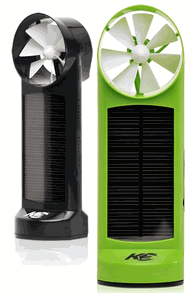
Here is a unique charger that can be powered both by solar power as well as by wind energy.  The gadget has a built-in solar panel which coverts solar energy into an electric charge which can be used to charge your mobile phone, iPod, camera  etc. A mini turbine mounted on the top rotates when placed against the wind and turns an internal dynamo which again generates electricity. The rechargeable internal battery of the gadget  can also be charged by a normal ac charger.
K3 Solar and Wind Charger
The gadget is quite useful when you are travelling, trekking or camping. It’s one of a very few portable gadgets which charge by wind energy and is a perfect alternative to conventional charges, especially when you have no access to electricity. The gadget can be arranged on your motorcycle or jeep so that it directly faces the wind while you are driving.  Under standard conditions, an hour of sunlight and a sufficientlystrong wind should charge your  phone for about 30 minutes of talking.
The device has an USB port which can be used to connect it to an external power source such as from a computer or a vehicle power outlet. It also comes with a mini and micro USB tip making it useful for a vast variety of phones. A built-in LED power indicator shows the current power status
The K3 Solar and Wind charger is priced at $99.95 and can be purchased from the below link.
http://www.earthtechproducts.com/k3-solar-and-wind-charger.html
Dimensions: 3 Inches in Length, 3.1 inches wide and a height of 9.3 inches
Color: Green and black with a white mini turbine
Weight: 10.6 Ounces
Battery specifications: Rechargeable Lithium ion cell (4000mAh) DC output- 5V 1amp 5W
The package includes a the K3 Solar and Wind Charger gadget, multiple device tips, USB cable AC Wall Adapter, a handy drawstring bag and a user guide.

News

Two passengers on the missing Malaysia Airlines Flight MH370 were travelling on stolen passports, it has been confirmed, as authorities, including the FBI, investigate whether the disaster was the result of a terrorist act.

Whatever happened to the Boeing 777 high above the South China Sea, it was quick and gave the pilots no time to issue a mayday, although there were reports that another Malaysia Airlines pilot flying ahead of the missing flight had managed to contact the plane at the request of air traffic control authorities.

There were also suggestions from the Malaysian Maritime Enforcement Agency that the plane may have attempted to turn around, after it spotted oil slicks about 20 nautical miles south of the plane's last point of contact.

Click for more photos

Malaysia Airlines plane goes missing

Dato'Azharuddin Abdul Rahman, Director General of DCA, briefs the media that Malaysia Airlines fight MH370 is still missing. Photo: Getty Images

Neither of the two Europeans whose passports had been stolen were on the aircraft. The Italian, Luigi Maraldi, was travelling in Thailand and the Austrian, Christian Kozel, aged 30, was located in his homeland.

Advertisement

Both the men lost their passports in Phuket, the holiday island in Thailand.

The New York Times reported on Sunday the two passengers who used the fraudulently obtained passports bought one-way tickets issued last week at the same travel agency in a shopping mall in the Thailand beach resort of Pattaya, according to electronic booking records.

A woman who answered the phone at the travel agency said she was “too busy to talk.”

It is unclear how the men traveled south to Malaysia to board the flight on Saturday. In Beijing, each man was to continue on to separate European cities, according to the electronic records, The Times reported. As transit passengers, they would not have been required to obtain Chinese visas.

Security experts in Asia said the use of false travel documents is a persistent problem in the region, but differed on the significance of the two stolen passports to the investigation.

Xu Ke, a lecturer at the Zhejiang Police College in eastern China who studies aviation safety and hijackings and has advised the Chinese authorities, said the two men might have been illegal migrants.

But Steve Vickers, the chief executive of a Hong Kong-based security consulting company that specializes in risk mitigation and corporate intelligence in Asia, said the presence of at least two travelers with stolen passports aboard a single jet was rare and a potential clue.

“It is fairly unusual to have more than one person flying on a flight with a stolen passport,” said Mr. Vickers, who publicly warned a month ago that stolen airport passes and other identity documents in Asia merited a crackdown.

“The future of this investigation lies in who really checked in and what they looked like,” he added.

Mr. Azharuddin, the Malaysian civil aviation chief, said investigators were reviewing video footage of the passengers, including their check-in bags.

Malaysia's acting Transport Minister Hishammuddin Hussein said on Sunday investigators were checking the entire passenger list and that counter-terrorism units and the FBI have been informed.

At one stage on Sunday Malaysian authorities said there were four passengers travelling on suspicious documents, but they later revised it back to two.

Asked whether this was a security lapse, Mr Hishammuddin said "Let us not jump to conclusions and make wild speculation."

However, terrorism expert Greg Barton, of Monash University's School of Political and Social Inquiry, said modern aircraft did not just vanish from the sky and when they did, a bomb was almost always the first suspect.

''Things will become clearer once wreckage or debris is found,'' he said.

''Beijing’s reticence at linking the disappearance with terrorists is noticeable, but if debris or a black box indicates a midair explosion, expect the Uighurs [a Muslim people from the restive far western Chinese region of Xinjiang] to come into contention.''

According to the New Straits Times newspaper, contact was briefly made with the aircraft before it vanished. It was being flown by Captain Zaharie Ahmad Shah, a highly experienced pilot, and first officer Fariq ab Hamid.

''We managed to establish contact with MH370 just after 1.30am and asked them if they have transferred into Vietnamese airspace,'' a pilot on another Malaysian Airline flight told the New Straits Times.

''The voice on the other side could have been either Captain Zaharie or Fariq, but I was sure it was the co-pilot.

''There were a lot of interference ... static ... but I heard mumbling from the other end. That was the last time we heard from them, as we lost the connection,’’ he said.

Across the world, the mysterious disappearance of the Boeing 777 is playing on most travellers’ fear of flying.

Vietnamese air force planes spotted two large oil slicks close to where the plane was presumed to have gone down in pitch darkness early on Saturday.

The slicks were the first possible indication that the aircraft, bound for Beijing and carrying 239 people, had crashed.

Passengers and crew came from at least 14 countries and included six Australians – Robert and Catherine Lawton, Rodney and Mary Burrows and Gu Naijun and Li Yuan. There were 154 Chinese nationals, 38 Malaysians, seven Indonesians, five Indians, four French and three Americans.Malaysia, China, the Philippines, US and Singapore have deployed ships and planes to the search area, which had been widened after radar signals indicated the plane may have turned back.

Malaysian Air Force General Rodzali Daud said this theory was based on military radar. ‘‘We looked back at the records – there was an indication the plane may have turned back,’’ he said.

The Malaysian maritime agency’s director-general Amdan Kurish, who joined in the search, said his team spotted ‘‘two or three’’ patches of yellowish oil slick about 16 kilometres long.

''A ship has been dispatched to the location of the slick to take samples so we could test whether the oil is from a plane,’’ Mr Amdan said.

Even so, no trace of the aircraft has yet been found, and this failure has prompted speculation about what caused the disappearance. Apart from terrorism, other possibilities include airframe failure, bad weather, pilot disorientation, engine failure, hijacking, pilot suicide and being shot down.

David Learmount, operations and safety editor at Flightglobal media, said modern aircraft were ‘‘incredibly reliable and you do not get some sudden structural failure in flight – it just doesn’t happen’’.

Malaysia Airlines has a good safety record, as does the Boeing 777. Boeing has manufactured 1030 of the aircraft and they had not had a fatal crash in their 19-year history until an Asiana Airlines plane crashed in San Francisco last year, killing three passengers.

However, the missing Malaysia Airlines 777 is reportedly the same aircraft that crashed into the tail of another plane while taxiing at Shanghai’s Pudong International Airport in August 2012.

An independent accident-tracking website, Aviation Safety Network, listed the accident and claimed damaged suffered by the Boeing 777 was ‘‘substantial ... the tip of the wing of the Malaysia Airlines Boeing 777 was broken off and hung on the tail of the China Eastern Airbus 340-600, according to pictures posted by passengers on the internet’’.

At a news conference in Beijing on Sunday, Ignatius Ong, chief executive of Malaysia Airlines subsidiary Firefly airlines, said the plane was last inspected 10 days ago and was "in proper condition".

Prime Minister Tony Abbott would not speculate whether terrorism was involved in the crash.

He has offered Malaysia two Australian aircraft to assist with the search.

"This afternoon I spoke to Malaysian Prime Minister Najib Razak to convey Australia's condolences on the loss of Malaysia Airlines Flight 370 and offer our assistance with the search for the missing aircraft," he said in a statement.

"On behalf of Australia, I offered two RAAF P-3C maritime surveillance aircraft to help with the search for the missing aircraft."

"The P-3C Orion is a long-range maritime surveillance aircraft ideally suited to this task."

Prime Minister Najib accepted the offer and the first aircraft was due to depart from Darwin on Sunday night.

The disappearance of Flight MH370 paralleled the loss of Air France Flight 447, an Airbus 300, travelling from Rio de Janeiro to Paris, in June 2009. It fell into the Atlantic, killing all 216 passengers and 12 crew.

A report the following year found a combination of technical faults and human error led to the crash.

Heavy turbulence caused air-speed sensors to malfunction while the captain was taking a rest break and the plane began to stall.

A spokeswoman for the Department of Foreign Affairs and Trade said the families of Australians listed on the flight had been contacted: ‘‘Australian consular officials are in urgent and ongoing contact with local authorities and with Malaysia Airlines including on efforts to locate the missing flight.’